The Benefits of Creative Play: Why Imagination Is Serious Developmental Business
To an adult eye, a child playing with blocks is just playing. To a developmental neuroscientist, the same child is engaged in spatial reasoning, problem-solving, hypothesis testing, frustration tolerance, and creative cognition simultaneously. The block tower is not idle entertainment — it is developmental work, conducted in the medium children were born to work in: play.
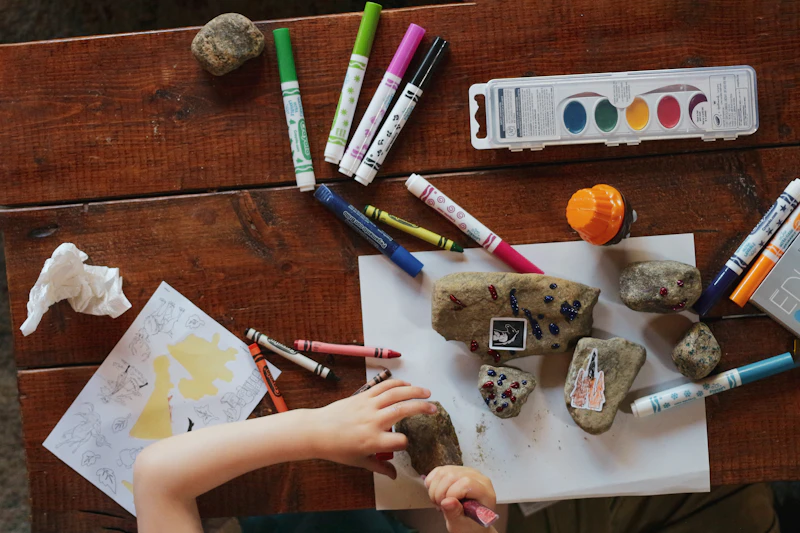
Creative play encompasses a broad range of activities united by one essential feature: the child is generating, imagining, and directing, rather than receiving. Pretend play, open-ended art, construction, storytelling, music-making — all of these are forms of creative play, and all of them are doing something profound in the developing brain.
The Science of Pretend Play
Pretend play — also called dramatic play, imaginative play, or symbolic play — emerges around 18 months and becomes increasingly sophisticated throughout the preschool years. It is one of the most studied phenomena in developmental psychology, and the findings are consistently striking.
When a child plays pretend, they are doing something cognitively demanding: holding two realities in mind simultaneously. The banana is a banana and also a phone. They are themselves and also the doctor. This dual representation — the ability to hold a pretend reality alongside the actual reality without confusing the two — is a significant cognitive achievement that research links to strong performance on theory of mind tasks, which measure the ability to understand that others have different thoughts and perspectives from one's own.
Research from the American Academy of Pediatrics consistently supports unstructured play — including imaginative play — as essential to healthy child development, noting that children who engage in rich pretend play show stronger language skills, social competence, and emotional regulation than those with more limited play experiences.
Executive Function: The Hidden Benefit of Play
Executive function refers to the cognitive skills that allow us to plan, focus, control impulses, and manage multiple tasks simultaneously. These skills, centered in the prefrontal cortex, predict academic success, mental health outcomes, and professional achievement more reliably than IQ alone. And they are profoundly shaped by play.
When children engage in imaginative play, they are exercising executive function constantly:
- Rule-following: Pretend play requires adherence to the scenario's rules. A child playing "restaurant" must stay in role, follow the agreed narrative, and suppress behaviors that don't fit the game.
- Impulse control: When playing "baby," the child who is "oldest sibling" must suppress their own desires to maintain the game structure.
- Working memory: Keeping track of a complex pretend scenario requires holding and manipulating significant amounts of information in mind.
- Cognitive flexibility: Adapting when the scenario changes, negotiating new rules, incorporating new players — all require flexible thinking.
The research of developmental psychologist Dr. Adele Diamond has been particularly influential in documenting the relationship between pretend play and executive function development, with implications for school readiness that have reshaped early childhood education practice.
Emotional Processing Through Play
Play is where children process the experiences of their lives in ways that feel safe and manageable. The child who plays "doctor" repeatedly after a medical procedure is not just re-enacting the event — they are working through it cognitively and emotionally, moving from passive patient to active controller of the narrative. Play therapists rely on this fact; it is the mechanism by which play therapy works.
Creative play provides a safe container for exploring scary feelings, rehearsing difficult scenarios, and processing overwhelming experiences at a tolerable distance. The pretend dimension of play gives children what the real world often can't: the ability to control outcomes, replay situations, and experiment with different responses without real consequences.
This is one reason why children who are allowed to play freely — including "dark" themes in their play, like death, conflict, and scary scenarios — often show better emotional regulation than those whose play is heavily sanitized. Processing difficult feelings through play is healthier than suppressing them. Supporting this understanding, our guide on helping toddlers navigate big emotions explores the importance of giving children space for full emotional expression.
Language Development and Storytelling
Imaginative play is a language laboratory. Children in pretend play use, on average, more sophisticated vocabulary and more complex sentence structures than in any other context — because the scenarios they're enacting demand language that describes hypothetical situations, social roles, and emotional states. "Pretend you're the queen and I'm the knight coming to warn you" requires conditional, subjunctive, and role-specific language that casual conversation rarely reaches.
The storytelling inherent in dramatic play — with its characters, conflicts, and resolutions — also develops narrative understanding that directly supports reading comprehension. Children who engage in rich pretend play enter school with stronger story schemas: they understand that stories have structure, characters, and cause-and-effect relationships. This makes learning to read considerably easier, as we explore in our reading readiness guide.
Open-Ended Art: Process Over Product
Open-ended art activities — where children are given materials and freedom rather than a model to copy — are among the most developmentally rich activities available to young children. The value lies in the process, not the product. When a child is mixing paint colors out of curiosity, not following an instruction, they are conducting genuine scientific inquiry: forming a hypothesis (what happens if I mix red and blue?), testing it, observing the result, and adjusting their understanding.
The CDC's developmental guidelines identify creative expression as a key component of healthy early childhood development. Open-ended art supports fine motor development, spatial reasoning, problem-solving, emotional expression, and the fundamental belief that one's ideas are worth expressing — a belief at the foundation of all creative and intellectual confidence.
Supporting Creative Play at Home
The most effective thing parents can do for their child's creative play development is largely a matter of provision and restraint:
Provide Open-Ended Materials
The toys that support the richest creative play are often the simplest. Blocks, fabric and dress-up materials, art supplies, cardboard boxes, sand and water, and simple figurines or animals support imaginative scenarios that electronic toys with fixed functions cannot. When a toy does everything, the child does nothing — there's nothing to imagine. When the material is open, the imagination fills the space.
Protect Unscheduled Time
Creative play requires time — not 15 minutes between activities, but long stretches where children can develop and deepen a play scenario over an hour or more. Over-scheduled children lose this time. Protecting long blocks of unstructured time in the day is one of the most important things parents can do for creative development.
Follow Their Lead
When invited into a child's play, follow their scenario rather than redirecting it. They are the director; you are the actor. "What should I do now?" is the most powerful question in play. Children in charge of their own play learn that their ideas are worthy of realization — a belief that is foundational to creativity, confidence, and leadership.
Resist the Urge to Improve
The purple grass and orange sky in your child's drawing are not errors to correct. They are evidence of freedom. When we teach children that there is a right way to draw grass, we teach them to suppress their own perception in favor of conventional expectation — which is the opposite of what creative play is designed to do.
"Imagination is more important than knowledge. For knowledge is limited, whereas imagination embraces the entire world." — Albert Einstein
Outdoor Creative Play
The outdoors offers creative play possibilities that indoor environments fundamentally cannot replicate. Natural materials — sticks, stones, mud, sand, leaves, water — are infinitely varied and responsive in ways that manufactured toys are not. A stick can be a wand, a sword, a measuring rod, a paintbrush, and a violin bow in the same afternoon. The creative possibilities of the natural world are explored in depth in our guide to the power of outdoor play.
The Long Game
The benefits of rich creative play in early childhood extend far beyond childhood. Adults who engaged in abundant imaginative play as children show higher levels of creativity, stronger social skills, more flexible thinking, greater emotional resilience, and better capacity for perspective-taking than those with less play-rich childhoods. The world's most innovative thinkers — scientists, artists, entrepreneurs, educators — consistently describe childhoods saturated with imaginative, open-ended play.
When your child spends an afternoon playing house, building an imaginary city from cushions and boxes, or creating elaborate stories with figurines, they are not wasting time. They are doing the most important developmental work available to them. Your job is simply to protect that time and trust that something profound is happening in the apparently ordinary activity of play.
Want to stay updated on our journey?
Join our mailing list